![2020Logo_CanDo.png]](https://wissen.can-do.de/hs-fs/hubfs/2020Logo_CanDo.png?height=50&name=2020Logo_CanDo.png)
In practice, however, it becomes clear: two levels truly determine the success of a solution.
A. True differentiating factors – which define the actual added value
B. Common knockout criteria – which are defined as must-have requirements and lead to immediate exclusion if not met
Below, we have summarized both levels – including the key unique selling points of Can Do and the most common knockout criteria based on our experience in direct system comparisons.
A. Key differentiating factors of Can Do
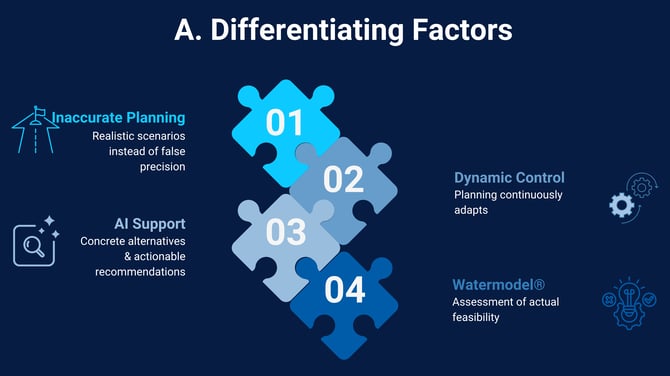
1. Planning with Uncertainty – Instead of False Precision
The future is rarely clear-cut. Can Do reflects this reality. Instead of enforcing artificial precision, Can Do deliberately allows for uncertainty in planning—just as it exists in real life:
-
Project start: sometime in Q3 2026
-
Project duration: between 9 and 12 months
The software continuously evaluates these plans in real time and makes the following visible:
-
Risks
-
Overloads
-
Feasibility of the plan
It evaluates all planning scenarios and shows whether they are realistically achievable in combination with all ongoing and planned projects, resources, and initiatives.
The difference compared to other solutions:
Many systems require exact planning values—creating a level of precision that doesn’t actually exist. The result: high maintenance effort and constant plan adjustments because reality does not match.
Benefit of Can Do software:
More realistic planning, less effort—and reliable risk assessment before problems arise.
2. Dynamic Project Control Instead of Static Planning
Projects evolve continuously—resource availability changes, priorities shift, and progress differs from the original plan. Can Do consistently reflects this reality.
Instead of static planning, Can Do enables dynamic, continuously adaptive control based on current data. Changes immediately impact plans and analyses—without manual recalculation or time-consuming re-planning.
This creates not a static plan, but a living system that always reflects the current state of the organization and provides a solid basis for real-time decision-making.
Through the continuous updating of all planning data, deviations and bottlenecks become immediately visible. Risks do not only emerge in reports or status meetings, but are made transparent during ongoing operations. In this way, a continuous, data-driven approach to risk management emerges – not as a separate process, but as a direct consequence of ongoing planning and control.
The difference compared to other solutions:
Many systems rely on static plans that must be manually adjusted when changes occur. This leads to delays, inconsistencies, and high maintenance effort.
Benefit of Can Do software:
Greater responsiveness, better decision quality, and significantly reduced planning effort—with maximum transparency.
3. AI-Supported Analysis and Suggestions for Alternative Resources
Can Do uses AI where it creates real value: in concrete planning decisions.
If a planned resource becomes unavailable, the AI automatically analyzes qualifications, availability, and constraints—and immediately suggests suitable alternatives. A detected problem is instantly turned into a clear course of action.
In addition, visual heatmaps provide an instant overview of where the biggest bottlenecks are—whether at the level of individual resources, specific skills, or entire departments.
The difference compared to other solutions:
Many tools display data—but without meaningful logic behind it. Can Do evaluates situations, derives actionable options, and makes planning not only transparent but directly executable.
Benefit of Can Do software:
Critical situations are immediately visible—and can be addressed in a targeted way.
4. Watermodel® Strategies (Patented)
People do not work like machines. When handling multiple tasks in parallel, individuals organize their workday themselves—sometimes focusing more here, sometimes there. What matters is that everything is completed on time.
Traditional planning tools ignore this. They rigidly sum up workloads and report overload—even when the person could realistically organize their work to handle everything. The result: false alarms, unnecessary planning effort, and mistrust in the planning process.
Can Do takes a different approach. The patented Watermodel® algorithm simulates how a person could realistically distribute their parallel tasks. It analyzes all possible combinations—and only indicates an overload risk when no feasible solution actually exists.
The micromanagement of daily self-organization remains where it belongs: with the resource itself. The planner does not need to manage this.
The difference compared to other solutions:
Other systems report overload even when none exists—because they simply add up workloads instead of simulating them. This creates noise instead of clarity.
Benefit of Can Do software:
Fewer false alarms, less planning effort—and risk warnings you can truly trust.
👉 Learn more about Watermodel® → Watermodel® explained | Watermodel® strategies in detail
B. Common Knockout Criteria in System Comparison
Some requirements are non-negotiable. If they are not met, the solution is eliminated—regardless of all other strengths.
.png?width=670&height=377&name=USP%20und%20KO%20Kriterien%20EN%20(1).png)
1. End-to-End, Cross-Project Resource Planning
A key criterion in software selection is the ability to plan resources not only within individual projects, but across the entire organization.
Can Do enables seamless planning across all projects—from the strategic portfolio level down to detailed operational planning. Resources can be planned both generically and at the individual employee level.
This is particularly critical in corporate groups or internationally operating organizations, where resources must be deployed and managed across organizational boundaries.
The difference compared to other solutions:
Many systems operate in project silos. A company-wide resource view is either missing or can only be achieved with significant effort and workarounds.
Benefit of Can Do software:
End-to-end management of all resources—across projects, locations, and business units.
2. Multi-Tenancy and Flexible Data Spaces Within a Single System
A key knock-out criterion in software selection is the ability to structurally separate different organizational units within one system.
Companies require clearly defined data spaces—for example for legal entities, countries, or locations, as well as internal departments such as R&D or HR. Not all information should be visible system-wide; it must be selectively restricted.
Can Do enables this separation through a flexible organizational and permission structure. Organizational units can be clearly isolated while still allowing overarching control and consolidated reporting—e.g., at the holding level.
The difference compared to other solutions:
Many systems offer either full data separation (classic multi-tenancy) or a centralized view without sufficient differentiation. A consistent combination of both is often lacking.
Benefit of Can Do software:
Clear separation of data spaces combined with centralized control and transparent reporting across all organizational units.
3. Granular Role and Permission Concept
Who can see what—and who cannot? In complex organizations, this is not a technical detail, but a business-critical requirement.
Can Do provides a finely tuned permission concept with inheritance logic and customizable settings at every level. Within defined structures, access rights can be precisely controlled without hindering collaboration.
Especially in cross-entity resource allocation, legal considerations can quickly arise—for example in the context of disguised employee leasing. A clean permission and visibility concept is essential for secure governance.
The difference compared to other solutions:
Many solutions offer only basic role concepts. Access rights can only be differentiated to a limited extent, leading to insufficient transparency and potential legal risks.
Benefit of Can Do software:
Clear and secure control of access and responsibilities—even in complex organizational structures and cross-company collaboration.
4. Complete Audit Trail with Data Protection Compliance
Another key must-have criterion in software selection is full traceability of all changes.
Can Do documents, across all object levels, who made which changes and when—creating a reliable foundation for plan vs. actual comparisons and audit-proof analyses.
At the same time, data protection and co-determination requirements are consistently taken into account.
The difference compared to other solutions:
Many solutions offer only limited or incomplete histories, making it impossible to fully trace changes.
Benefit of Can Do software:
Full transparency and traceability while ensuring compliance with data protection and regulatory requirements.
Conclusion: Innovation Meets Reliability
Successful systems achieve two things: real differentiation in planning and control logic—and reliable fulfillment of key must-have criteria in organization, governance, and compliance.
Can Do combines both: innovative approaches such as uncertainty-based planning, AI-supported decision-making, and the patented Watermodel®—together with the fundamental requirements that are decisive in any serious selection process: company-wide resource planning, multi-tenancy, granular permissions, and a complete audit trail.
A combination that not only delivers today—but remains sustainable in the long term.